
Your Complete Guide to a Basement Bathroom Remodel
- oliverjames0609
- 2 days ago
- 16 min read
Adding a bathroom in your basement is a fantastic move. It boosts your home's value and makes that lower level so much more usable. But let's be real—it's not just about picking out tile and a vanity. Basement projects have their own unique quirks, from plumbing puzzles to keeping things dry and bright. Getting it right means starting with a solid game plan.
Your Basement Bathroom Remodel Blueprint
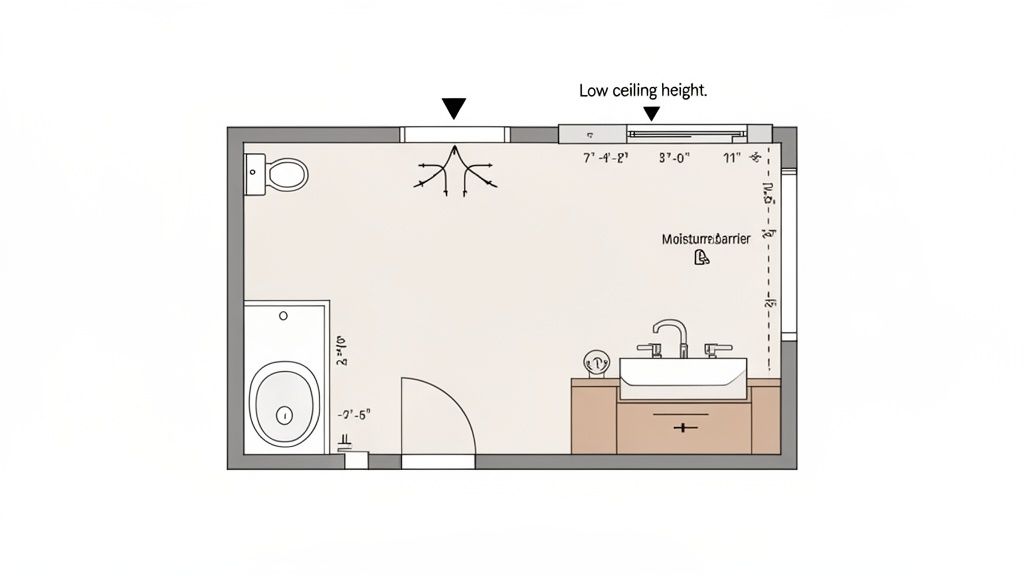
Before you even think about swinging a sledgehammer, you need a plan. For a basement bathroom, this is non-negotiable. You're building below ground, and that comes with a different set of rules. Think of this planning stage as a reality check—it’s where you spot the potential headaches and figure out solutions before they turn into expensive nightmares.
An upstairs bathroom has gravity on its side. In the basement, you’re often fighting against it. That simple fact adds a layer of complexity that you have to think through from the very beginning. How you handle these initial checks will shape everything that follows, from your budget to the final look and feel of the room.
Key Feasibility Checks
Before you get lost in design ideas, you have to get a handle on the bones of the space. This is the stuff that will make or break your basement bathroom remodel.
Ceiling Height: Grab a tape measure. Most building codes demand a finished ceiling height of at least 7 feet. Measure from the concrete floor up to the joists to see what you're working with. If it's tight, you'll need to get creative with things like low-profile lighting to keep the room from feeling like a cave.
Plumbing Access: Find your home's main drainpipe, often called the soil stack. The closer you can build your new bathroom to it, the easier (and cheaper) the plumbing will be. The big question is how you’ll get waste from the new fixtures up and into that main line.
Ventilation Path: Every bathroom needs a good exhaust fan, and it must vent all the way outside—not just into the ceiling space. You need to map out a clear path for the ductwork to run from the fan to an exterior wall.
Tackling Moisture and Light
Basements are naturally cool, dark, and sometimes damp. Your plan has to tackle these two issues head-on if you want to create a space that’s actually pleasant to be in.
When it comes to any basement project, your top priority should be preventing basement water damage. Getting serious about waterproofing isn't just a good idea; it's absolutely essential to protect your hard work and investment.
Waterproofing the foundation walls and floor is your first line of defense. After that, it's all about choosing the right materials. For instance, you'll want to explore waterproof options from the many bathroom tile types available here: https://www.decor8.ai/post/top-10-bathroom-tile-types-to-consider-for-your-2025-renovation. Stick with inorganic materials that won’t feed mold or mildew.
To combat the darkness, think in layers. A mix of recessed overhead lights, good task lighting around the vanity, and maybe even some accent lighting can make a huge difference. It can turn a gloomy corner into a space that feels bright and inviting.
Navigating Permits and Building Codes
Alright, let's talk about the part of the project that makes most homeowners groan: permits and building codes. I get it. It feels like a mountain of red tape designed to slow you down. But after years in this business, I can tell you to think of it differently. This process is actually your project’s built-in quality control. It’s what ensures your new bathroom is safe, works correctly, and won’t become a nightmare later on.
Tempted to skip it? Don't. I've seen the fallout from unpermitted work—from having to tear out brand-new tile for an inspection to major headaches when trying to sell the house. More importantly, these rules are there to protect your family from very real dangers, like shoddy wiring or a plumbing leak hidden inside a wall.
Why Permits Are Not Optional
When it comes to plumbing and electrical work, permits aren’t just a friendly suggestion; they're the law in most places. Anytime you’re adding or changing your home's core systems—plumbing, electrical, or structural—you're going to need a permit. A new basement bathroom hits that trifecta.
Getting a permit kicks off a series of crucial inspections. A local inspector will come out at different stages to make sure the work is up to code, from how the pipes are sloped to ensuring the outlets near the sink are the right kind. This expert, third-party sign-off is invaluable for your safety and your home's value.
A lot of people think permits are just a cash grab by the city. The reality is, they're a safety net. They ensure the work is done by the book, protecting your investment and preventing contractors from taking dangerous shortcuts.
Common Code Requirements to Have on Your Radar
Building codes can feel a bit mysterious and they definitely change from town to town. That said, a few rules are pretty much universal for basement bathrooms. Knowing these from the get-go will save you a ton of headaches.
Ceiling Height: You’ll almost always need a finished ceiling height of at least 7 feet above the main fixtures (toilet, sink, shower). This is a basic requirement to make sure the room is a legitimate, usable living space.
Ventilation: Every bathroom needs a mechanical exhaust fan, and it absolutely must vent to the outside. A fan that just pushes damp air into the ceiling cavity is a recipe for a mold disaster and won't fly with an inspector.
GFCI Outlets: This one is a big safety item. Any electrical outlet in a bathroom has to have Ground Fault Circuit Interrupter (GFCI) protection. These are the outlets with the little "test" and "reset" buttons, and they're designed to instantly cut the power if they sense a short, preventing electrocution.
To get a clear picture of what your town requires, it’s always a good idea to check out a detailed guide like this ultimate building permit checklist and have a conversation with your local building department before you start swinging a hammer.
Respect Your Home's Bones
Last but not least, let's talk structure. The floor joists, beams, and support posts in your basement are holding your house up. It sounds obvious, but you'd be surprised how often people are tempted to mess with them.
That "quick notch" in a joist to fit a drainpipe might seem harmless, but you could be seriously weakening the floor above. Altering any load-bearing element is a job for a professional, and often requires a structural engineer to draw up a plan for redistributing the weight safely. Don’t gamble with your home’s integrity—leave the structural work to the pros.
Solving The Basement Plumbing Puzzle
Let's talk about the biggest hurdle in any basement bathroom project. It’s not about choosing the perfect tile or finding a vanity that fits. The real challenge is plumbing.
Upstairs, gravity is your best friend. Everything flows downhill and away, just as it should. But in a basement, you're below your home's main drain line. You're fighting gravity, not working with it.
Imagine your upstairs toilet is at the top of a waterslide. Easy. A basement toilet is at the bottom. You need a powerful, reliable way to get everything from the bottom of that slide all the way back up to the exit. This single problem defines the entire plumbing strategy for your new bathroom.
Your Three Main Plumbing Options
Thankfully, plumbers have come up with some pretty smart solutions to this problem. There are three main ways to tackle it, and each one fits a different situation, budget, and tolerance for construction mess. Knowing the basics will help you have a much better conversation with your contractor.
Up-Flushing Toilets (Macerating Systems): This is often the path of least resistance. These special toilets have a built-in pump and grinder. The blades turn waste into a fine slurry, which is then easily pumped up to the main drain through a small pipe.
Sewage Ejector Pumps: This is the classic, heavy-duty solution. It involves cutting into your concrete floor to install a sealed basin. All the bathroom fixtures drain into this basin. Once it’s full, a powerful pump automatically kicks on and forces the waste up and out.
Conventional Gravity-Fed Drains: This is the most disruptive and expensive option. It means breaking up the concrete floor to dig trenches for new pipes. These pipes have to be sloped just right to let gravity do the work, eventually tying into the main drain.
To help you see how these stack up, here’s a quick comparison.
Comparing Your Basement Plumbing Options
Each system has its clear strengths and weaknesses. The right choice depends entirely on your project's scope, from a simple half-bath to a full bathroom with a shower and tub.
Plumbing Option | How It Works | Best For | Pros | Cons |
|---|---|---|---|---|
Up-Flushing Toilet | A pump with macerating (grinding) blades turns waste into a slurry and pumps it up to the main drain. | Adding a simple toilet or half-bath where breaking concrete is not an option. | Least invasive installation; lower labor cost; self-contained unit. | Can be noisy; not ideal for handling shower water; may have a shorter lifespan. |
Sewage Ejector Pump | A sealed basin collects waste from all fixtures. A float-triggered pump ejects waste up to the sewer line. | Full bathrooms with a shower or tub; long-term, reliable solutions. | Very reliable; can handle high water volume; can connect multiple fixtures. | Requires cutting concrete; more complex installation; needs a dedicated vent line. |
Gravity-Fed Drain | New pipes are installed under the concrete, sloped to allow waste to flow down to the main drain naturally. | New construction or when the main drain is accessible at a low enough point. | No mechanical parts to fail; silent operation; feels like an upstairs bathroom. | Most expensive and disruptive; requires extensive concrete and excavation work. |
Making the right call here is crucial. Choosing an underpowered system for a full bathroom, for instance, is a recipe for future headaches.
How To Choose The Right System
If you're just adding a simple powder room and want to avoid a major mess, an up-flushing toilet is a fantastic solution. For ideas on how to make a small space like that feel amazing, check out our guide on how to transform your powder room into a luxurious oasis.
But if you’re dreaming of a full bathroom with a shower, a sewage ejector pump is almost always the way to go. Its basin and pump are built to handle the large volume of water from a shower—something a macerating toilet just isn't designed for. Yes, it means cutting a hole in your floor, but it provides a rock-solid system for years to come.
Trenching for a conventional gravity-fed system? That's the big one. It's the most labor-intensive and costly approach, usually reserved for new construction or in rare cases where the home's main drain is already low enough to make it work.
Think of the plumbing system as the heart of your new bathroom. Trying to save a few dollars here can lead to clogs, backups, and expensive emergency calls later. It's always worth it to invest in the right system for your needs from the get-go.
This decision tree gives you a good idea of how to start thinking about the project—and highlights why permits are so important, especially when you're messing with plumbing.

As you can see, the moment you touch plumbing or electrical, you're going to need a permit. That’s why getting these core systems planned out correctly from day one is non-negotiable.
How to Budget Your Basement Bathroom Remodel
Let's talk about the most crucial part of your basement bathroom project: the budget. Getting this right from the start is the difference between a smooth, exciting renovation and a project that becomes a major headache.
A basement bathroom isn't like its upstairs counterpart. You're dealing with concrete floors, potential moisture issues, and complex plumbing, all of which can affect the final price tag. Think of your budget not as a single number, but as a detailed financial roadmap that accounts for materials, fixtures, and especially, skilled labor.
Deconstructing the Costs of a Basement Bathroom
Every little decision you make, from the toilet you choose to the tile for the shower, will influence your total spend. But a few key areas have the biggest impact on the bottom line.
Plumbing System: This is a big one. As we covered earlier, choosing between an up-flushing toilet, a sewage ejector pump, or a traditional gravity-fed system will dramatically shift your costs. An ejector pump, for instance, means breaking up concrete and calling in the pros, which can add thousands to your budget.
Fixtures and Finishes: Here's where you have the most flexibility. A simple vanity and faucet from a home improvement store might only set you back a few hundred dollars. On the other hand, a custom-built vanity with a stone top can easily run into the thousands. The same principle applies to everything from lighting to mirrors.
Labor Costs: Don't ever underestimate this part of the budget. Labor often makes up 40% to 65% of the total project cost. This isn't just for framing and drywall; it's for the licensed plumbers and electricians who make sure your new bathroom is safe, functional, and up to code.
Realistic Cost Ranges and What to Expect
So, what should you really expect to pay? Industry data for 2025 shows that a full basement remodel averages around $22,802. Adding a bathroom to that project typically adds another $6,600 to $16,500 to the total. It’s a perfect example of how a small space can take up a big chunk of the budget, mostly because of the complicated systems it requires.
A classic rookie mistake is to only budget for the things you can see, like the sink or the showerhead. The real budget-busters are almost always hidden behind the walls—the plumbing, the electrical, and the waterproofing that make it all work.
Smart Saving Strategies and Contingency Planning
While some costs are unavoidable, there are plenty of smart ways to save money without compromising on quality. For example, high-end luxury vinyl tile (LVT) can give you that beautiful, waterproof look of porcelain for a much lower price. We've got more great ideas in our guide to DIY interior design on a budget that actually looks expensive.
Here are a few more pro tips for keeping your budget in check:
Get Multiple Quotes: Don't just go with the first contractor you talk to. Get at least three detailed quotes. This helps you find a fair price and gives you a much clearer picture of what the job actually involves.
Choose Stock Over Custom: A pre-made vanity from a big-box store will almost always be cheaper than a custom piece. You can always give it a high-end feel with new hardware or a coat of paint.
Plan for the Unexpected: This is absolutely essential for a basement project. Always, always set aside a contingency fund of 15-20% of your total budget. This "oops" fund will cover surprises, like finding a crack in the foundation or needing to reroute old pipes, without derailing your entire project.
Smart Layouts and Material Choices for Basements
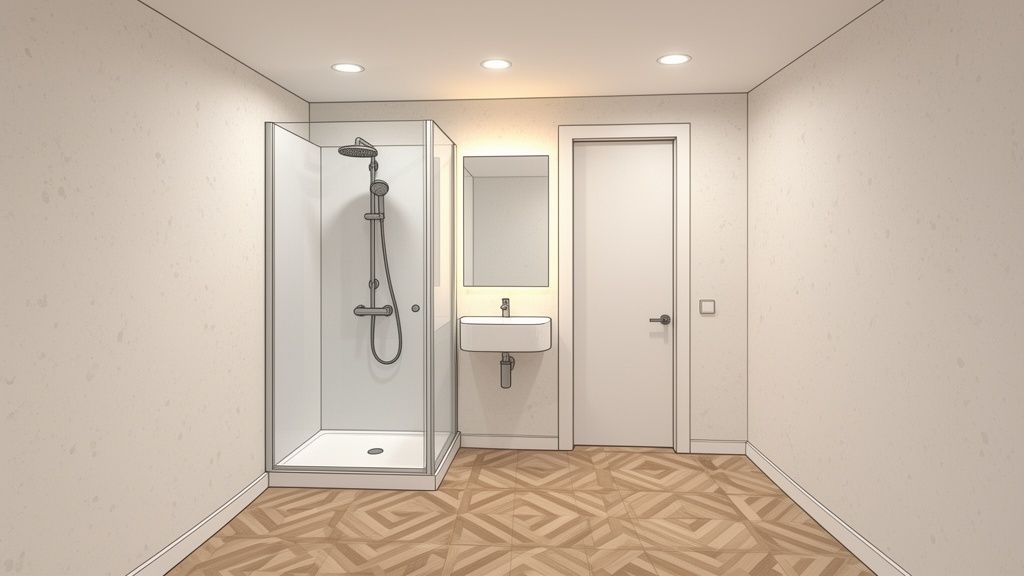
Now that we’ve navigated the heavy lifting of plumbing and permits, we get to the fun part: designing a basement bathroom remodel that's both smart and stylish. A basement throws a few curveballs your way, like tight spaces and dampness, but with the right approach, these challenges become opportunities for clever, beautiful design.
Think of it like packing for a trip. You wouldn't bring a parka to the beach, right? The same logic applies here—you can't use materials meant for a dry, upstairs bedroom in a below-grade bathroom. Every choice has to be intentional and ready for the environment.
Maximizing Space with Smart Layouts
Basement bathrooms often need to fit into awkward nooks and crannies. The real goal isn't just to cram everything in, but to create a layout that feels surprisingly open and works smoothly, no matter how small the footprint.
Here are a few proven tactics that make a huge difference:
Corner Showers: Ditch the bulky rectangular shower. A neo-angle or rounded corner shower can instantly free up floor space and make moving around much easier.
Wall-Mounted Fixtures: A wall-mounted toilet and vanity are your secret weapons. By lifting them off the floor, you create an illusion of a bigger room, plus cleaning underneath is a breeze.
Pocket or Barn Doors: A standard door swinging inward can gobble up nearly 10 square feet of usable space. A pocket door that vanishes into the wall or a trendy barn door that slides alongside it gives you all that space back.
The best basement bathroom layouts don't fight the existing structure—they work with it. Design your plan around support columns and ductwork to avoid expensive relocation work and make the most of every inch you have.
Choosing Materials That Thrive Below Ground
This is where your basement bathroom will either stand the test of time or become a headache. The number one rule is to fight moisture at every turn. That means picking materials that are either completely waterproof or highly water-resistant.
Don't worry, focusing on durability doesn't mean sacrificing style. Today’s materials deliver incredible performance and look fantastic, protecting your investment from mold, mildew, and water damage. For wall ideas that look great and hold up to humidity, check out our guide to beadboard paneling bathroom transformations.
Here are the top material choices for a truly tough basement bathroom:
Flooring: Porcelain tile and luxury vinyl tile (LVT) are the undisputed champs here. Both are 100% waterproof, incredibly durable, and come in countless styles that convincingly mimic everything from hardwood to natural stone.
Walls: Start with mold-resistant drywall (often called green board or purple board). For the shower and tub surrounds, you have to use a proper waterproof membrane behind tile, solid-surface panels, or acrylic inserts.
Paint: Don't just use any leftover paint. Finish your walls with a high-quality paint made specifically for bathrooms. These formulas contain mildewcides to stop mold growth and have a durable finish that helps repel moisture.
Lighting and Visualization Strategies
Good lighting can completely transform a space. In a basement with no windows, it's absolutely essential. The trick is to layer your lighting to get rid of shadows and create a warm, inviting feel. Start with general overhead light (like recessed cans), add bright task lighting around the vanity mirror, and maybe even an accent light in a shower niche.
Before you buy anything, though, you need to see how it will all come together. This is where modern design tools are a game-changer. An AI-powered platform like Decor8 AI lets you upload a photo of your unfinished basement and instantly test out different layouts, tile, and paint colors in your actual space. It takes the guesswork out of the process, so you can finalize your design with total confidence.
Given the technical skill involved, it's no surprise that 84% of homeowners hire pros for bathroom renovations. A well-planned space is always in demand, and getting it right, especially below ground, often requires an expert touch.
Maximizing Your Return on Investment
Adding a bathroom to your basement isn't just about convenience—it's one of the smartest financial moves you can make for your home. When you finish a basement, you're already adding valuable square footage. But tossing a bathroom into the mix? That’s how you supercharge your return on investment.
Think about it from a buyer's perspective. A finished basement is nice, but a finished basement with its own bathroom transforms the space. Suddenly, it’s not just a bonus room; it's a potential guest suite, a teenager's dream hangout, or even a self-contained apartment. That kind of utility is what makes buyers open up their wallets.
Protecting Your Investment
Of course, to get that great return, you have to make smart choices from the get-go. This is all about playing the long game with quality and classic style.
Choose Timeless Finishes: That funky tile you saw on Instagram might look great today, but it could scream "dated" in five years. Stick with neutral, classic designs for tile and fixtures to appeal to the broadest range of buyers down the road.
Insist on Quality Workmanship: Cutting corners on plumbing or electrical work is a recipe for disaster and will absolutely sink your ROI. Always hire licensed pros who know what they're doing.
Permit Everything: Don't even think about skipping the permits. They are your official proof that the job was done to code, which is crucial for both insurance and a hassle-free sale.
A well-executed basement bathroom remodel isn't just an expense; it's a strategic upgrade. Every decision should be viewed through the lens of adding lasting, marketable value to your property.
The numbers don't lie. According to 2025 remodeling data, basement projects that include a bathroom pack a serious financial punch. While a basic basement remodel typically recoups around 63.4% of its cost, a midrange bathroom renovation can see a return closer to 80%. When you combine them, you create a powerful selling point that real estate agents love. You can dig into more details in the 2025 Cost vs. Value reports on CustomCraftDBR.com.
Once the work is done, you'll want to show it off in the best possible light. To learn how to make your new space irresistible to buyers, check out our guide comparing virtual staging vs. traditional staging.
Got Questions About Your Basement Bathroom? I've Got Answers.
Adding a bathroom to your basement is a smart move, but it's totally normal to have a long list of questions before you start. Getting these things sorted out now will save you a world of headaches and unexpected costs down the road. Let's tackle some of the most common things homeowners ask me.
How Much Headroom Do I Actually Need?
This is the big one—the question that can make or break the entire project. In nearly every jurisdiction, building codes mandate a finished ceiling height of at least 7 feet for a bathroom. This isn't just a random number; it's what keeps the space from feeling like a cramped cave and ensures it's legally considered a habitable room.
Before you get too far, grab a tape measure. Go from the concrete floor straight up to the bottom of the joists. Don't forget to subtract a few inches for whatever flooring and ceiling material you plan to install. If you find yourself coming up a little short, don't despair just yet. You can use a few design sleights of hand to create a sense of height:
Go Vertical: Tall, narrow tiles or even subtle vertical stripes in the paint can trick the eye into looking up.
Keep it Slim: Choose low-profile recessed lighting instead of fixtures that hang down and eat up precious inches of headroom.
Float Your Vanity: Mounting the vanity to the wall exposes more floor space, making the entire room feel bigger and more open.
Can I Really DIY This Project?
I get it—the urge to save a bundle by doing the work yourself is powerful. But a basement bathroom is a whole different animal from painting a bedroom. The best approach for most people is a hybrid one: you handle the finishes, and you call in the pros for the heavy lifting.
Here's a simple rule I live by: if a mistake could lead to a flood, fire, or structural problem, it's a job for a licensed professional. Messing up plumbing or electrical work isn't just dangerous; it can void your insurance and become a massive red flag when you decide to sell your house.
Think of it this way:
Tasks a Confident DIYer Can Tackle | Jobs You Absolutely Should Hire Out |
|---|---|
Painting the walls and ceiling | All plumbing—especially connecting to main drain lines |
Assembling and installing a vanity | All electrical work, from running wires to installing GFCI outlets |
Laying down click-lock vinyl flooring | Any work that involves cutting into joists or support beams |
Installing baseboards and trim | Serious waterproofing and sump pump installation |
What's the Best Flooring for a Basement Bathroom?
Your flooring choice is critical. Basements are inherently damp, so you need a material that is 100% waterproof and can stand up to the challenge. Forget about hardwood or laminate down here.
You really have two standout choices: luxury vinyl tile (LVT) or porcelain/ceramic tile. LVT is a real winner because it's warmer and softer underfoot than tile, a breeze to install for most DIYers, and does an amazing job of looking like real wood or stone. On the other hand, porcelain tile is the classic, bulletproof option. When installed and grouted properly, it creates a surface that water simply cannot penetrate.
Ready to stop guessing and start seeing? With a tool like Decor8 AI, you can snap a photo of your empty basement and instantly see what different layouts, tiles, and fixtures will look like in your actual space. Give it a try for free on www.decor8.ai and turn that basement vision into a concrete plan.
Comments